Choose a stone for the habit you want to keep
A crystal quiz is most useful when it helps you make a small, clear choice. Here, that choice is a stone to represent something you want to practice: pausing, beginning, focusing, setting a boundary, being kinder, or communicating. You choose the intention; the result offers a reminder and a concrete next action.
The meanings below are this page's symbolic associations. They are not mineral properties, diagnoses, predictions, or evidence that a stone changes your health. You do not need to believe in crystal energy to use a colored object as a personal symbol.
Compare the six stones
You can use this comparison directly without completing the quiz. Start with the action you want to repeat, then choose a stone whose appearance you enjoy. There is no need to collect all six.
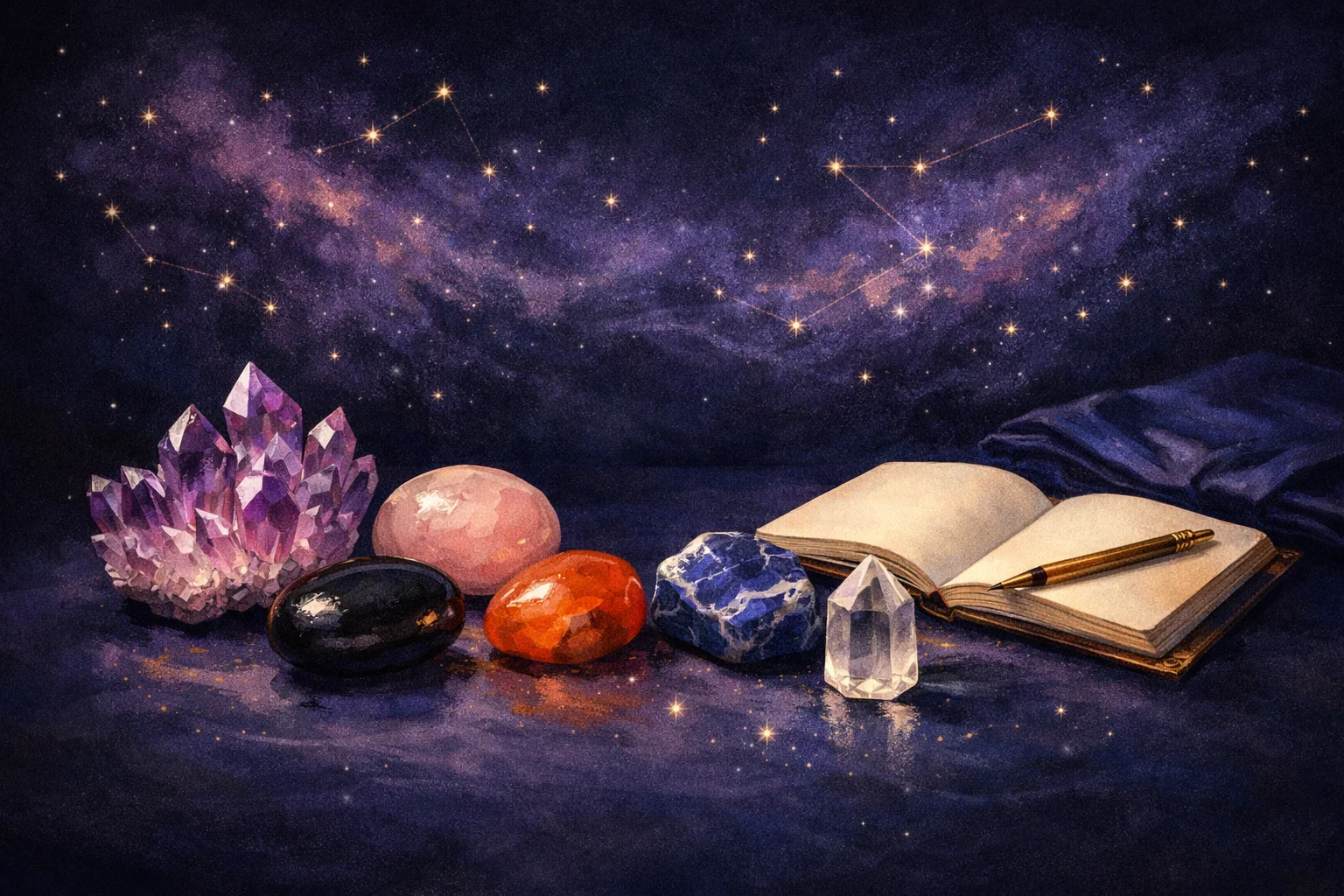
| Stone | Reminder | Small action |
|---|---|---|
| Amethyst | Make room for a quiet pause | Close my notebook at the end of the day |
| Carnelian | Begin a creative task | Make one rough sketch or first draft |
| Clear quartz | Choose one priority | Write one task before opening my apps |
| Obsidian | Keep a personal boundary | Check my availability before saying yes |
| Rose quartz | Practice a kinder response | Rewrite one harsh sentence more fairly |
| Sodalite | Express an idea clearly | Draft one clear sentence before a conversation |
For example, amethyst and clear quartz both work here as reminders to slow down, but they point to different actions. The amethyst prompt ends a work session; the clear quartz prompt chooses what to do next. Rose quartz's kindness prompt is about how you speak to yourself. It does not promise love from another person.
How the scoring works, with examples
Each answer maps to exactly one stone using the table above. Intention gives that stone 3 points, the habit gives 2, and appearance gives 1. These weights are an editorial heuristic: what you want to practice matters more than color. The largest possible score is 6. Skipping leaves that question out; it does not award points or increase the remaining weights.
Example 1 — a clear preference: choose “Make room for a quiet pause,” “Close my notebook at the end of the day,” and “Blue with white patches.” Amethyst gets 3 + 2 = 5 points. Sodalite gets 1. The other four get 0. Amethyst leads because the intention and habit agree, although you prefer blue.
Example 2 — an honest tie: choose “Practice a kinder response,” “Check my availability before saying yes,” and “Black.” Rose quartz gets 3 points; obsidian gets 2 + 1 = 3. Both appear as joint matches. Choose the kindness reminder if you want to change your wording, or the boundary reminder if you want to check your calendar before agreeing.
Example 3 — only one answer: skip the first two questions and choose “Purple.” Amethyst gets 1 point and every other stone gets 0. The tool labels this an appearance-only match. It has no basis for inferring what habit you need. If you skip everything, it asks for one answer rather than inventing a result.
There is no random draw or hidden personality score. The same answers give the same comparison. You can disagree with the ranking: a personally meaningful stone can be a better choice for you than the highest-scoring one.
Turn a match into a practice
- Choose a visible place. Put your reminder beside the notebook, calendar, or materials involved in the action. A stone in a drawer is easy to forget.
- Name the moment and action. For a sodalite match: “Before my next conversation, I will write the one point I want to make.” Keep the action small enough to do in an ordinary day.
- Review what you did. After a few opportunities, ask whether you noticed the reminder and took the action. Change the location or wording if it was easy to overlook.
You can write the stone's name on a card, use the picture above, or choose an object you already have. The practice depends on the action you choose. A more expensive specimen does not earn a higher score or a stronger result.
If your starting question is about your temperament rather than choosing an object, the zodiac element quiz explores a symbolic blend of fire, earth, air, and water. The aura color quiz offers a different color-based reflection. Neither result is required to select a stone here.
The material is real; the intention is yours
Amethyst is purple quartz; colorless quartz is also called rock crystal. These are material descriptions, independent of our pause and priority prompts. See GIA's explanation of quartz varieties. Rose quartz takes its name from its pink color, as described in GIA's rose quartz guide.
Obsidian is volcanic glass, so the everyday label “crystal quiz” is broader than a strict mineral category. Rapid cooling can prevent crystals from forming; the National Park Service explains obsidian's formation. Our boundary association is a writing prompt, not a geological property of the glass.
For a loose amethyst specimen, GIA advises avoiding sudden temperature changes and notes that prolonged intense light can fade some amethyst. Warm, soapy water is a suitable cleaning method; steam cleaning is not recommended. See GIA's amethyst care guidance. For rose quartz, GIA also recommends warm, soapy water and advises against steam or ultrasonic cleaning in its rose quartz care guide. Do not assume those instructions apply to every material, coating, or jewelry setting; check guidance for the actual item you own.
The illustration and quiz cannot authenticate a specimen or establish where it was mined. If you choose to buy one, ask for the material's name, any disclosed treatments, and care instructions. You can complete every reflection on this page without buying anything.