The Sun Tarot Card: The Deck's Brightest Card and the One Thing It Asks of You
The Sun tarot card meaning is the one most readers get only half right. Card 19 gets filed under “the good card” and then nobody looks any closer, which is a shame, because The Sun is the only Major Arcana card that makes a demand of you rather than a promise. Its demand is visibility. Everything this card offers — clarity, vitality, success that other people can actually see — is conditional on you stepping into the open and letting it be witnessed.
I've watched this card land in a lot of readings, and the reaction is remarkably consistent. People relax, then immediately start negotiating. “Yes, but the timing” — “yes, but I don't want to jinx it.” The Sun has no patience for that. Of the 78 cards, it's the least ambiguous one you can draw, and arguing with it is usually the actual problem the reading came to surface.
The Deck's Happiest Card Still Asks Something of You
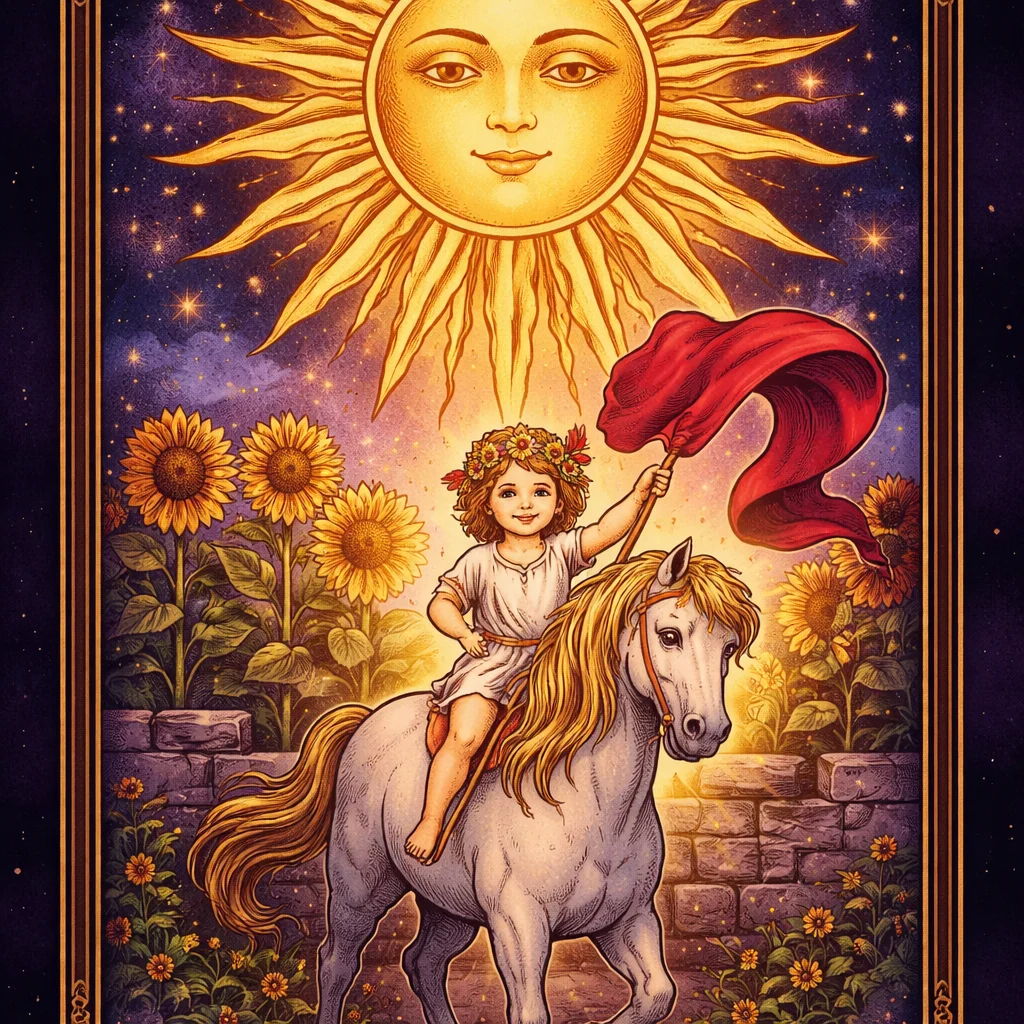
Look at what's literally happening in the image. The child is out in the open, on an unsaddled horse, holding a banner the size of a bedsheet. Nothing about that composition is subtle. Compare it to the card that comes right before it — The Moon and its fog of half-seen shapes — and the contrast is the point. The Moon hides, The Sun exposes. Both are neutral about whether you enjoy the experience.
That's the piece people miss. Full daylight is wonderful when you have nothing to conceal and genuinely uncomfortable when you do. In a reading about a secret relationship, an unannounced job hunt, or money nobody in the household knows about, The Sun is one of the more alarming cards on the table. It doesn't punish anyone. It just removes the cover, and then the situation resolves itself the way exposed situations always do.
Numerology backs this reading. Nineteen reduces to 1 + 9 = 10, and 10 reduces again to 1 — The Magician, the card of visible personal power. The Sun is what The Magician's ambition looks like after eighteen cards of being tested. Same energy, no more need to prove it.
Leo's Tarot Card Is Strength, Not The Sun
Here's the correction that separates a decent reader from a sloppy one. Because the Sun rules Leo in astrology, people assume The Sun card belongs to Leo. It doesn't. In the Golden Dawn system of correspondences that modern tarot inherited, Leo's card is Strength (VIII), the card of the woman and the lion. The Sun card is attributed to the Sun itself — the luminary, not the sign.
This is not pedantry, and it changes how the card reads. Sign-based Majors carry that sign's baggage: The Star inherits Aquarius's detachment, Death inherits Scorpio's intensity. The Sun inherits nothing, because it isn't filtered through a sign at all. That is exactly why it has no meaningful shadow side and why its reversal is so mild compared to almost every other card in the deck.
Practically: Strength is the private work of mastering something inside you. The Sun is what it looks like from the outside once that work is done. If both turn up in the same spread, you're usually being shown the before and after of the same struggle.
The Four Sunflowers Are Facing the Wrong Way
Pull up any Rider-Waite-Smith Sun card and look at the flowers behind the wall. There are four of them, and they are not turned toward the sun. They're turned toward the child. Real sunflowers track the light; Pamela Colman Smith drew them tracking the person. It's one of the quietest details in the deck and one of the most useful, because it tells you the card is about being a source of warmth, not just a recipient of it.
The count matters too. Four sunflowers, four suits — the whole Minor Arcana condensed into the background of a single Major. That gives you a fast diagnostic when The Sun appears and you're not sure what part of life it's pointing at:
| Sunflower | Element | What it asks under The Sun |
|---|---|---|
| Wands | Fire | Is there anything you're making purely because you want to? |
| Cups | Water | Who actually knows how you feel? |
| Swords | Air | What are you thinking clearly but saying vaguely? |
| Pentacles | Earth | What does this joy look like in something you can touch? |
The stone wall those flowers grow behind is worth a second of attention as well. It sits between the child and the garden, and the child has already ridden out past it. Whatever the wall represented — caution, the family you grew up in, the version of yourself that needed protecting — the card catches you on the far side of it. If you want the historical thread on how this imagery was fixed in 1909, the Rider-Waite-Smith Sun card has a documented lineage back through much older Marseille designs, where two children stood where this one rides alone.
Why a Child on a Bareback Horse?
Waite could have put an adult on that card. He put a child there because the card is about a specific quality that adults tend to lose and occasionally get back: the ability to be happy without performing it or explaining it. A child on a horse with no saddle and no reins isn't being reckless. They simply haven't learned to expect a fall.
The white horse is the deck's recurring symbol for pure, uncomplicated force — the same animal Death rides, though to a very different end. And there's a red feather in the child's wreath. That feather appears exactly three times in the Major Arcana: on The Fool at the very start of the journey, on Death's banner at the point of transformation, and here. It marks the same fearlessness at three stages: untested, surrendered, and finally earned.
So when The Sun shows up in a reading about confidence, it isn't telling you to fake bravado. It's pointing at a specific kind of ease you probably had once, before you started calculating how things would look.
Upright or Reversed: Is the Joy Real or Performed?
Upright, The Sun is straightforward: the good thing is real, it's visible, and you're allowed to enjoy it. In a yes-or-no reading it's the strongest affirmative in the deck — stronger than the Ace of Cups, stronger than The World. If you want a single-card answer to one specific question, a focused yes or no tarot pull that lands on The Sun is about as clear as tarot gets.
Reversed is where readers overreact. The Sun reversed is not a dark card. It's the same sun with cloud cover, and it splits into three practical readings:
- Delayed, not denied. The success is coming and you're early. Nothing to fix.
- Arrived, not accepted. The good thing already happened and you won't let yourself have it. This is the most common version by a wide margin.
- Performed, not felt. Public brightness over private flatness — the version worth taking seriously, because it usually means something else needs attention.
Telling them apart is easier than it sounds. Ask the querent to describe the good news in one sentence. Hedged language points to the second reading; flat, over-cheerful language points to the third.
The Sun vs. The World: Two Kinds of Success
These two get confused constantly, and the difference is genuinely useful at the table. Both are “good” cards. They describe completely different moments.
| The Sun (XIX) | The World (XXI) | |
|---|---|---|
| Attribution | The Sun (luminary) | Saturn |
| What it marks | Clarity and vitality returning | A full cycle closing |
| Timing | Now, and it holds | The end of a long arc |
| What it asks | Be seen. Stop hedging. | Admit it's finished. |
| Common misread | “Everything is fixed now” | “There's nothing ahead” |
The shorthand I use: The World closes a chapter, The Sun lights one you're still standing in. If a querent asks “is this over?” and pulls The Sun, the honest answer is no — it's working, and it's continuing.
The Combinations That Dim The Sun
A card this bright is easy to read alone and easy to over-read in company. These are the pairings that actually change the verdict:
- Sun + Seven of Cups. The good news is real, but you're fantasising about the wrong version of it. Pin down which specific outcome you're counting on.
- Sun + Five of Pentacles. Visible success, private scarcity. Classic for someone whose life looks enviable from outside and thin from inside.
- Sun + The Moon. The strongest fog-lifting pair in the deck. Whatever was unclear stops being unclear, usually faster than the querent wants.
- Sun + Ten of Cups. The traditional family and fertility pairing, and the reason The Sun sits on most readers' pregnancy shortlist.
- Sun + Three of Swords. Joy that costs someone else something. Worth naming out loud rather than skipping past.
One last thing to carry into your next reading. The Sun's child isn't holding that banner for himself — you don't need a flag that size to signal to nobody. The card assumes an audience. If The Sun keeps turning up for you and nothing seems to shift, the question worth sitting with isn't whether the good thing is real. It's who you still haven't told.