How to Read This Moon Phase Calendar and Its Estimates
Use the calendar to explore a selected date and an approximate place in the lunar cycle. On opening the page, it uses your browser's current date. Select a day to change the result, use the month arrows to move through the calendar, and choose Today to return. The phase name, illumination and Moon sign are estimates; the reflection panel is a separate symbolic interpretation.
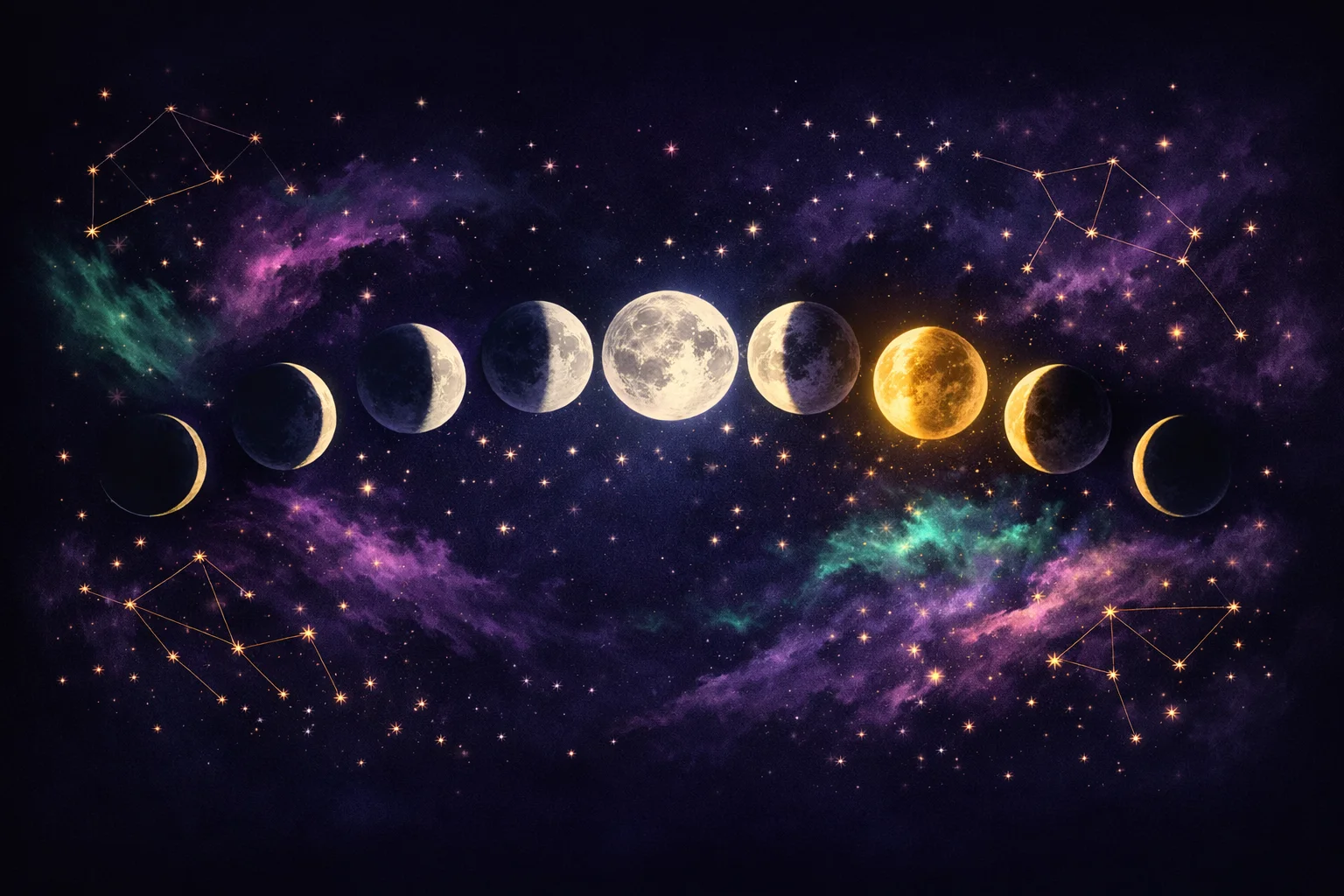
Phase names and the model
The lunar phase cycle averages about 29.5 days. Astronomical new moon, first quarter, full moon and last quarter are defined moments. Crescent and gibbous phases describe the intervals between them. See the U.S. Naval Observatory explanation of phases and illumination.
| Phase | Appearance and direction |
|---|---|
| New Moon | The illuminated side faces away from Earth. |
| Waxing Crescent | Less than half illuminated; increasing. |
| First Quarter | Half illuminated; increasing. |
| Waxing Gibbous | More than half illuminated; increasing. |
| Full Moon | The illuminated side faces Earth. |
| Waning Gibbous | More than half illuminated; decreasing. |
| Last Quarter | Half illuminated; decreasing. |
| Waning Crescent | Less than half illuminated; decreasing. |
This tool uses a simpler labeling rule: it divides a fixed 29.5306-day model cycle into eight equal bands, beginning at its reference new moon on January 6, 2000. Each band lasts about 3.7 model days. That is a display convention, not the physical duration of each phase. Illumination follows a smooth curve based on the same cycle; the upcoming dates are projections of that model. A “Full Moon” label here therefore does not establish the exact peak time.
New Moon and Full Moon
New moon and full moon are opposite points in the phase cycle. In a reflection practice, you might use the first as a reminder to begin something and the second to review it. Those meanings are optional. A calendar event does not show whether a project, conversation or relationship will succeed.
For example, choose one small goal at your first check-in, such as drafting a letter. At the next check-in, compare what you planned with what you did. You can move either check-in to fit your schedule. There is no need to wait for a phase if you already know a useful next step.
For a published event schedule, use the 2026 full moon calendar and check its EST/EDT time labels. For astronomical phase times in another year, use the USNO phase service. A local calendar date can differ from a date in another time zone.
What the Moon sign estimate means
The sign label comes from a simplified mean-longitude calculation, separate from the phase estimate. It does not include all the corrections used by a full ephemeris. Treat a placement near a sign boundary as uncertain, and do not use this calendar to establish a precise natal Moon sign.
For birth details, use the Moon sign calculator. For a more detailed calculation of the phase at a birth moment, use the birth Moon phase calculator. Both pages explain their inputs and methods. Astrological themes attached to a sign are interpretations, not measurements of a person's emotions.
A simple reflection log
Record the date, a brief observation and one question you want to revisit. You can add the phase if you enjoy following the cycle. Keep the observation separate from the interpretation: “I finished my draft” is an observation; “the waxing phase helped me finish” adds a cause that the log does not establish.
Read entries that fit your expectations and those that do not. A small personal log cannot separate lunar timing from workload, routines or other influences. Its useful output is a record of your experience, not proof that you should schedule important events around a phase.
Using a lunar gardening calendar
Some gardening traditions assign planting or harvesting tasks to lunar phases. This calendar displays phase estimates; it does not model plant growth, soil moisture, frost, temperature or crop requirements. Its output does not establish improved yields from a lunar schedule.
If you keep a garden log, record actual planting dates and conditions alongside any lunar theme you follow. Use crop-specific and local growing guidance for the practical schedule. A symbolic calendar cannot tell whether your soil or weather is suitable.
Optional reflection exercises
Begin: write one small goal and the first action it requires. Review: name what progressed and what needs changing. Finish: choose one completed task to acknowledge or one unnecessary commitment to reconsider.
These exercises can accompany any phase. You do not need special objects, a purchase or a particular belief. Stop at one useful question; the point is to leave with a clearer action, not to find a prediction in every date.